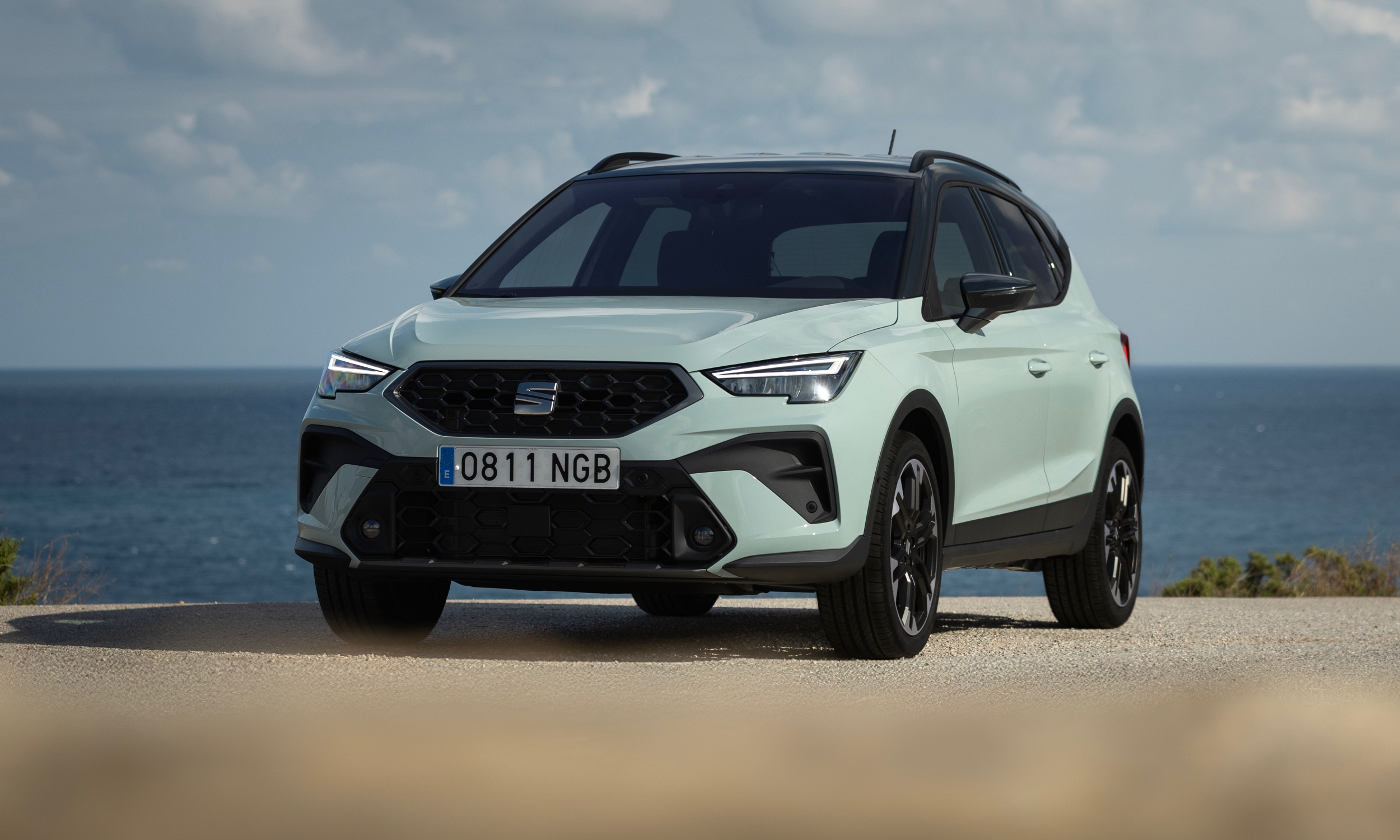
Seat launched the Seat Arona in the European market back in 2017 as a B-segment SUV , the brand's smallest crossover. Years have passed, and although it still looked fresh, it received a facelift in late 2021. We already had a first look at it during its national presentation, but we didn't miss the opportunity to test this new Seat Arona for a whole week.
As many of you know, the Seat Arona is the crossover sibling of the Ibiza . They share the same platform, many technical and design details, as well as the same engines. This time we tested it in its highest-performance version, that is, the FR trim with the 1.5 TSI 150 hp engine.
Few changes in the design of the Seat Arona
As always, we'll start by talking about its aesthetics. This restyling has barely introduced any aesthetic changes compared to previous versions, requiring us to look at very specific details to differentiate it. For example, the wheel designs are new, as is the model nameplate on the tailgate.
In this case, we're testing an Arona FR, which features redesigned bumpers and air intakes for a sportier look . Incidentally, the headlights are full LED starting with the Style trim level. Looking at the side profile, we see that this particular model has the optional two-tone paint scheme, using gray on the roof and Sapphire Blue on the rest of the body. The 18-inch wheels are also optional, and if you look closely, you'll see it comes with red brake calipers.

And now at the rear, from top to bottom, we have a roof spoiler, LED taillights with integrated daytime running lights, and the new Arona lettering in a handwritten style . I'm not entirely convinced by this, but oh well. We also see the FR badge, and at the bottom, we have these two inset exhaust outlets. Are they real? Well, no, the actual exhaust tips are hidden on the left side.
Inside it does improve, especially due to the new location of the screen
Moving inside, we're greeted by a newly designed steering wheel with a more refined look. It's, of course, multifunction and, in this case, includes paddle shifters for the automatic transmission. Behind it is the 10,25-inch digital instrument cluster , which displays a wealth of information and settings, yet is remarkably intuitive to use.

In the center of the dashboard, we see that Seat has repositioned certain elements, placing the screen in a more natural position . Previously, the air vents were at the top and the screen at the bottom. This 9,2-inch touchscreen is easy to use and feels fluid, although when starting the car, it takes almost a minute for everything to fully load. Incidentally, the screen in the lower trim levels is 8,25 inches.

Another new feature of this restyling is that the air vents are illuminated on the higher trim levels. It looks striking at night, but in my case, the left vent is reflected in the windshield right at the height of the rearview mirror, which isn't ideal.
Otherwise, the build quality is decent , mostly using rigid plastics that are well-fitted except for the central piece, which creaks when pressed. There are also good storage compartments, a wireless charging pad, and USB Type-C ports.
Good space in the rear seats and in the trunk

One advantage of the Seat Arona is its rear passenger space . The first thing to note is the excellent access, both in terms of door opening width and headroom, which is important to consider when traveling with elderly passengers and when placing children in their car seats.
Once inside, four adults of around 1,80 meters tall will travel with ample space , as legroom and headroom are good, though not exceptional. Furthermore, the generous glass area contributes to a feeling of spaciousness. The downsides are the noticeable transmission tunnel and the lack of air vents or USB ports in the second row.

And if we focus on the trunk , when we open the tailgate we find 400 liters of capacity. While not among the best in the B-SUV segment, it's roughly average, but the best thing is that its shape is practical because it's regular.
As is often the case with these cars, we don't have much depth, but we do have plenty of height. Under the floor we have a biscuit-type spare tire and this subwoofer from the audio equipment.
No trace of diesel or hybrids, only gasoline or CNG in the Arona
Moving on to the engines, the entry-level Seat Arona comes with a 1.0 TSI engine producing 95 hp, but the majority of sales are for the 1.0 TSI with 110 hp . It's a perfectly reasonable engine choice for this type of car, and it performs well. The top-of-the-range option is the 1.5 TSI with 150 hp, which is precisely the one we're testing and which I'll talk about in just a minute. There's also a CNG option, the 1.0 TGI with 90 hp, which I only recommend for very specific customers due to the limited number of CNG refueling stations.

The 1.0 TSI engine with 110 hp covers the needs of a wide range of customers, but not everyone. It's important to note that Seat has decided not to offer diesel engines in this car. If you drive a lot of kilometers throughout the year, you'll miss it. Another point to mention is that only the CNG option has an Eco label; the rest have a C sticker because there are no hybrids or mild hybrids available.
As I mentioned, this time we're testing the Seat Arona with the most powerful engine in the range, the 1.5 TSI . It develops 150 hp between 5.000 and 6.000 rpm and a maximum torque of 250 Nm between 1.500 and 3.500 rpm. It always comes with the 7-speed DSG transmission, and its performance figures include a 0 to 100 km/h time of 8,2 seconds and a top speed of 210 km/h. The official combined fuel consumption is 6,6 l/100 km. And now, let's get driving.
At the wheel of the 150 hp Seat Arona FR

So, we're now behind the wheel of the Seat Arona, and what can we say about it? Really, the most noteworthy thing is that it's not a perfect car in any one area, but it performs satisfactorily in all aspects . Thanks to the slightly elevated driving position and the large glass area, we have excellent visibility in the city.
But it's also a car that handles well on highways at normal speeds. In other words, you can take a long trip with a feeling of safety and good comfort, although I did miss having some kind of lumbar support in the front seats.

If we drive at a happy pace on winding roads, it does not have the dynamics of an Ibiza or a Leon, but it is not that the body tilts much either. Also, the steering is precise enough. In fact, with this 150 hp engine you can even have a good time considering the type of car it is.
And since I've mentioned the engine, it certainly offers more than enough power for the Arona. This 1.5 TSI has a very broad midrange and plenty of torque, allowing us to overtake and accelerate very quickly. In addition, the DSG dual-clutch transmission with paddle shifters works very well on the open road, although it can be a bit rougher in slow maneuvers, such as parking on an incline.
Consumption of the Seat Arona 150 CV
Regarding fuel consumption, since this engine has cylinder deactivation , it varies considerably depending on driving style. It's true that it consumes around 8 liters per 100 km in the city, which is something to keep in mind, but on the highway at 120 km/h it manages with 6 liters per 100 km, which is very good. Our average consumption this week has been 6,5 liters per 100 km.
Conclusions

We are finishing the test and, of course, it does not surprise me that the Seat Arona has been the best-selling car of 2021. It is a product that satisfies practically everything, with a design that you like, good interior space, good trunk and easy to use. ride. It is a practical car.
What I liked least about this facelift is that it doesn't change its exterior design at all and doesn't offer hybrid or diesel versions. Personally, I think the ideal engine for this car and for most of the Arona's target audience is the 1.0 TSI with 110 hp . I've driven it several times and it's capable of moving the car with sufficient ease, while maintaining reasonable fuel consumption.
In terms of price, the most affordable version starts at €17.800 . A highly recommended option is the Style Plus trim, which comes very well-equipped, with the 110 hp TSI engine and manual transmission, starting at €22.780. Finally, this test unit, with 150 hp, DSG transmission, and FR Plus trim, along with some optional extras, comes in at nearly €30.000.
Equipment Seat Arona

References
- Eco LED headlights
- Front fog lights with cornering function
- automatic city braking
- Cruise control and speed limiter
- Lane Keeping Assistant
- Fatigue detector
- 6 airbags
- Touch screen of 8,25 inches
- USB Type-C ports
- Front and rear electric windows
- On-board computer
- Air Conditioning
- 16-inch alloy wheels
- Roof bars
- Interior vents in honey color
- Trunk with double bottom
- folding rear seats
- Multifunction steering wheel
- Three rear head restraints
Style (add to Reference)
- Adaptive and predictive cruise control
- XDS differential (on versions over 100 hp)
- Rear disc brakes (on versions over 100 hp)
- Full LED headlights and taillights
- heated mirrors
- rear parking sensors
- chrome front grill
- Steering wheel, gear lever and handbrake in leather
- Chrome interior package
- Storage compartment under the front seats
- pockets on the backs
- Front center armrest
Style Plus (adds to Style)
- Navigator with 9,2-inch screen
- Wireless Full Link
- 10,25-inch digital instrument cluster
- Light and rain sensor
- Anti-glare interior mirror
- Automatic climate control
- Electrically folding mirrors
Xperience (adds to Style)
- Front and rear parking sensors
- automatic parking assistant
- Reversing camera
- Dual zone automatic climate control
- Wireless charger
- Keyless entry and start
- Specific Xperience bumpers
- 17-inch Dynamic alloy wheels
- Two-color body
- Mirrors in the same color as the roof
- Chrome roof rails and window frames
- Ambient lighting
- Nappa leather steering wheel
- green aerators
Xperience Plus (adds to Xperience)
- 9,2-inch screen with browser
- 10,25 inch digital box
- Signal recognition
- Illuminated interior vents
- Darkened rear windows
Xperience Plus XL (adds to Xperience Plus)
- lane keeping system
- traffic jam assistant
FR (adds to Xperience)
- Driving mode selector
- Recognition of traffic signs
- Seat Connect Information
- 9,2-inch touch screen and browser
- 16-inch Design wheels
- FR specific bumpers
- double exhaust outlet
- Interior vents in red
- Sports steering wheel and seats
FR Plus (adds to FR)
- Adaptive and predictive cruise control
- Lane Assist
- Traffic jam assistant
- automatic high beams
- illuminated aerators
- Dynamic Seating
- darkened glasses
Seat Arona Prices

| Motor | Change | Finished | Price |
|---|---|---|---|
| Motor | Change | Finished | Price |
| TSI 95 | Manual | References | 21.000 € |
| TSI 110 | Manual | Style | 22.580 € |
| TSI 110 | Manual | StylePlus | 22.780 € |
| TSI 110 | DSG | Style | 24.940 € |
| TSI 110 | DSG | StylePlus | 25.148 € |
| TSI 110 | Manual | XPerence | 26.030 € |
| TSI 110 | Manual | XperiencePlus | 26.238 € |
| TSI 110 | Manual | Xperience Plus XL | 26.383 € |
| TSI 110 | DSG | Xperience | 27.890 € |
| TSI 110 | DSG | XperiencePlus | 28.098 € |
| TSI 110 | DSG | Xperience Plus XL | 28.243 € |
| TSI 110 | Manual | FR | 25.400 € |
| TSI 110 | Manual | RF Plus | 25.500 € |
| TSI 110 | DSG | FR | 27.990 € |
| TSI 110 | DSG | RF Plus | 28.198 € |
| TSI 150 | DSG | FR | 29.570 € |
| TSI 150 | DSG | RF Plus | 29.778 € |
| TGI 90 | Manual | References | 22.240 € |
| TGI 90 | Manual | Style | 23.490 € |
| TGI 90 | Manual | StylePlus | 23.690 € |
| TGI 90 | Manual | Xperience | 26.370 € |
| TGI 90 | Manual | XperiencePlus | 26.570 € |
| TGI 90 | Manual | FR | 26.370 € |
| TGI 90 | Manual | RF Plus | 26.570 € |
Editor's opinion

- Editor's rating
- 4 star rating
- Excellent
- Seat Arona
- Review of: Diego Avila
- Posted on:
- Last modification:
- Exterior design
- interior design
- front seats
- rear seats
- Trunk
- Spring Suspension
- Consumption
- Comfort
- Price
Professionals
- Balance and versatility of the car
- dynamic response
- internal width
Cons
- Consumption in the city
- Some interior tweaks
- Few exterior changes in the restyling