

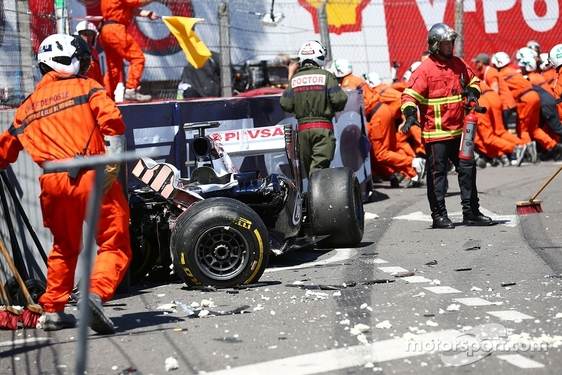
In the last Grand Prix, we witnessed two spectacular accidents, from which, fortunately, the drivers escaped unharmed. One involved Felipe Massa and his F138 at the Sainte-Dévote corner, and the other at Tabac, when Pastor Maldonado 's Williams FW35 literally flew through the air after crashing into the circuit's barriers, tearing them from their anchors and forcing a temporary suspension of the race.
In these two accidents, we were able to see how well the passive safety systems currently used in Formula 1 work, judging by the results, since the drivers emerged unscathed, albeit a little bruised. Two of these elements deserve mention: the cables that attach the wheels to the car's chassis to prevent them from flying off in the event of an accident, and the new protective barriers that replace the wheels that used to line the run-off areas.
In the onboard camera video, you can see that when Felipe Massa loses control and crashes into the barriers, the front left wheel flies off and heads towards the driver's head, but fortunately, the support cables did their job and prevented the tire from coming off the car, so it all ended in just a scare and some dented scrap metal.
This device, which began to be used in 1999 , has been continuously improved since then. The problem was that when the wheels detached from the car, they would fly off, and if they hit a driver or a track marshal, the weight and speed of the object could cause fatalities, as happened at the 2000 Italian Grand Prix and the 2001 Australian Grand Prix.
But at the beginning of this system's implementation, the cables continued to break, even in low-speed collisions. Then, starting in 2005, the load these components had to withstand was increased to six tons , and furthermore, from the 2011 season onward, in an attempt to improve the system even more, two cables are now used to support the wheels of the single-seaters. Currently, these safety devices are manufactured in Spain by a company called Future Fibres and are used in various international competitions, both in Formula 1 and in the Americas.
With current safety measures, in any racing car, the most serious accident is not a rollover, but a head-on collision with a stationary object , be it a tree or a house (as happens in some rallies), or with a wall, as in Formula 1. The driver's body may not suffer major damage, but the sudden deceleration that occurs when going from high speeds to zero is what the human body is unable to withstand.
Normally, several tire barriers were placed on circuits to protect the driver in the event of an accident, after passing through the run-off area and gravel trap. However, in some accidents, it was observed that Formula 1 cars drove through these tire barriers and into the wall , indicating that they weren't always functioning correctly. A prime example is Michael Schumacher's crash at the 1999 British Grand Prix, where, after flying through the tire barrier like a bullet, he ended up crashing into it and fracturing his ankle.
It was then that they realized something had to be done to improve safety. Technicians from a French company called Tec Pro designed new barriers: blocks of flexible, unbreakable polyethylene. These are filled with high-density, flexible, injected foam and reinforced with a metal plate. Tests on these structures resulted in 40% greater effectiveness at any speed and a reduction in deceleration forces to levels tolerable for the human body.
Its effectiveness has been demonstrated in accidents such as the one that occurred at the last race in Monaco, involving Venezuelan driver Pastor Maldonado, or in 2001, also on the same street circuit, with Mexican driver Sergio Pérez. Fortunately, more and more people are working to improve safety, both inside and outside the cars, so that we can enjoy a great spectacle while minimizing injuries. Even so, Formula 1 is a risky sport, and that should never be forgotten.
Source – The F1.com
Photo – Motorsport