

Mercedes' DAS (Dual Axis System) has been the "invention" of this season, the element that has generated the most attention from the media and engineers of other teams, and which will likely be a major talking point in the 2020 F1 season, if it finally arrives after this forced hiatus due to the global pandemic. Now we know why the Mercedes steering wheel can be lengthened or shortened on its steering column on the straights.
But now there's another system that could also generate some news. And that's the Ackermann geometry . It's not the same as the dual-steering system we saw in the Mercedes, but it is related to the front axle wheels and their toe-in. In fact, there's an effect called the Ackermann effect, which is what Mercedes has managed to implement, and Ferrari has also done so.
The Ackermann system likely originated with Mercedes for their W11, although it's not entirely new; it was used in the past, and Mercedes isn't the only team employing it. The Ferrari SF1000 , as I mentioned, has also implemented it. It seems Ferrari improved during testing, enhancing tire life on long runs during race simulations. This system, or the effect it achieves, is largely responsible for that improvement. It appears they tested it at the end of 2019 and refined it over the winter.
Therefore, when they remove the nose cone, you can see a sophisticated system of two pinions, two steering racks on both rocker arms. This allows the steering angle to be modified according to the radius of the curve. And this complexity is only seen in the Mercedes and the Ferrari. This is how they prevent the steering angle from remaining fixed in the curves.
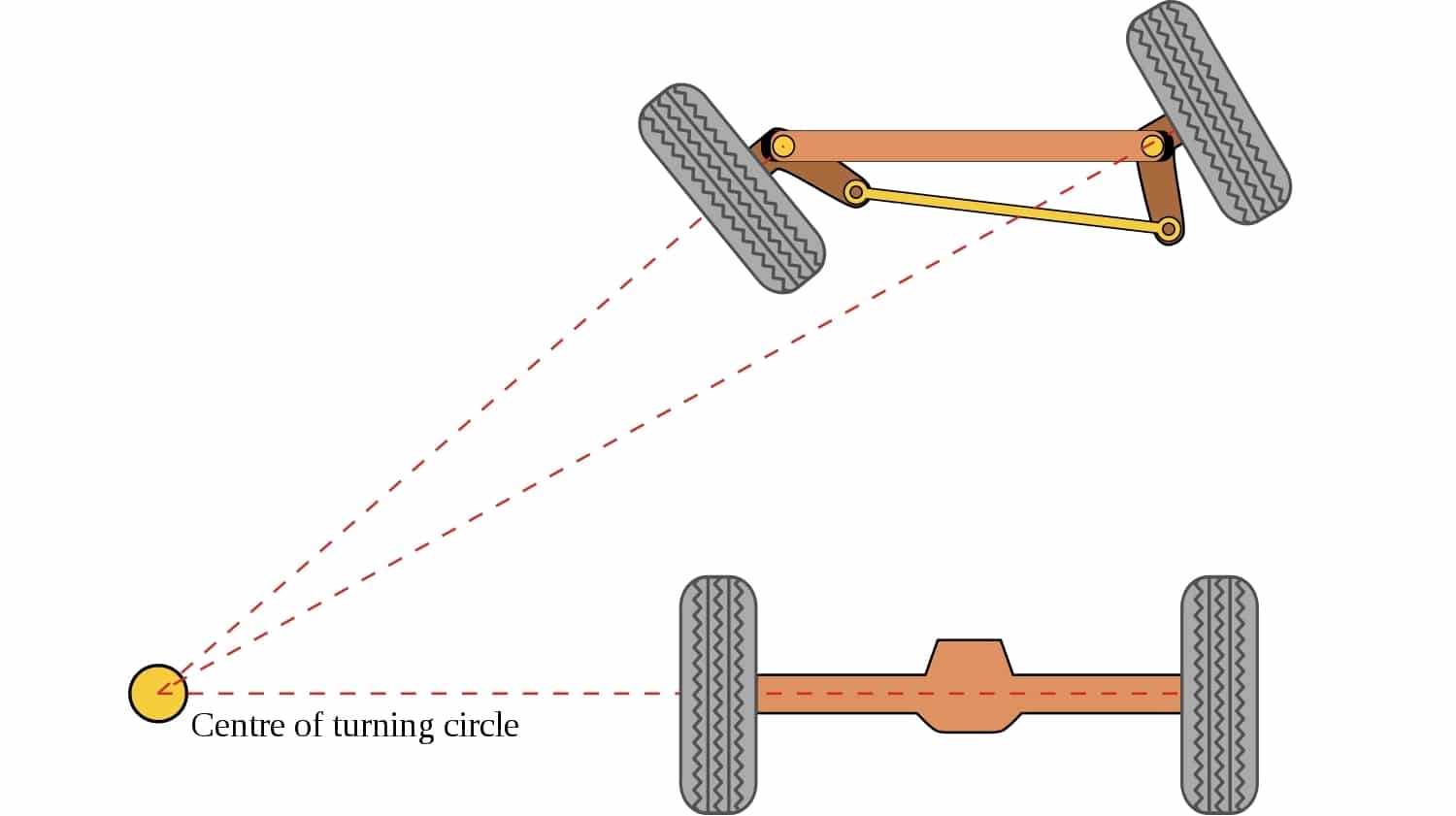
This Ackermann angle establishes the difference between the rotation of the inner and outer wheels. Note that, just as with the differential on the rear axle, the front wheels also follow different paths when considering the trajectory of each wheel.
Why? Well, Ackermann steering geometry solves problems when both wheels have to trace different radii in curves. If you notice, when cornering, the wheels don't turn at the same rate. If the wheels were parallel during the turn, the inside wheel would have to point towards the outside of the curve, making it harder to turn and causing some understeer. But Ackermann geometry allows the inside wheel to have a slightly greater turning angle than the outside wheel, eliminating this problem.