

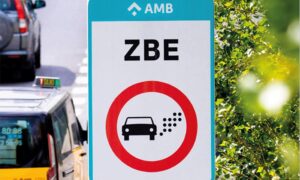
The implementation of Low Emission Zones (LEZs) in Spain has become a veritable legal and administrative labyrinth. What the 2021 Climate Change Law established as an obligation for all municipalities with more than 50.000 inhabitants has encountered a far more complex reality: court rulings that annul ordinances, city councils that are unable to implement them, and millions of euros in revenue from fines that could now be in jeopardy.
The latest episode unfolds in Málaga, where the High Court of Justice of Andalusia has annulled the traffic regulations for its Low Emission Zone (LEZ), ruling that they discriminate against drivers who are not registered residents. This decision follows similar rulings in Madrid, Catalonia, Asturias, and Castile and León, where courts have overturned these restrictions either partially or completely. Meanwhile, the central government, the Spanish Federation of Municipalities and Provinces (FEMP), and Brussels continue to push in the opposite direction, leaving drivers in a difficult-to-understand legal limbo.
A rollercoaster of sentences and fines in the courts
The most striking example is Madrid. The capital has collected over €105 million thanks to more than 1,08 million fines issued in its Low Emission Zones (LEZs) since their implementation. However, the High Court of Justice of Madrid (TSJM) overturned the Madrid Central low emission zones , and the Supreme Court rejected the City Council's appeal, making the ruling final in April 2026. Motorists' associations are already reporting over 3,3 million fines and a potential refund of around €650 million.
And the most Kafkaesque aspect: despite the final ruling, the speed cameras and access control devices remain operational, and the City Council continues to issue €200 fines for entering without an environmental sticker. Enforcement of the ruling is underway, but the local administration appears prepared to exhaust all legal avenues. Málaga, for its part, has already announced that it is considering an appeal or a modification of its regulations to maintain the restrictions, but the Andalusian ruling also calls into question the validity of the fines issued during the months they were in effect.
The problem is neither new nor unique to Spain. In France, Belgium, Italy, and Germany, there are also rulings against these zones. The difference here is that the courts are penalizing not the environmental substance, but the form it took: the ordinances were approved hastily and without sufficient economic impact studies or alternatives . The judges are not questioning the need to reduce pollution, but rather the legal validity of the local regulations.

The revenue: a side effect that raises alarms
Beyond the legal challenges, the economic impact of Low Emission Zones (LEZs) is one of the most controversial aspects. A report by the Madrid Regional Audit Office, which analyzed the period between 2022 and the first quarter of 2025, reveals that the city of Madrid earned almost €105 million from fines in its LEZs , a figure that contrasts sharply with the reality in other municipalities in the region. In Rivas Vaciamadrid, €1,1 million was collected from 18.047 fines, while Alcalá de Henares received €235.500 from 4.719 fines. Conversely, Boadilla del Monte recorded no violations, and Fuenlabrada issued 680 fines but generated no revenue for the city council.
Barcelona is no exception: it collects more than €10,7 million annually in fines from its Low Emission Zones (LEZs) , according to recently released figures. These sums have led drivers' advocacy groups to demand the return of all fines issued in areas where the ordinance has been repealed. The perception that these zones have become a money-making machine is increasingly difficult to refute, although city councils maintain that their primary objective is to improve air quality.
The outstanding issue: dozens of cities without an operational Low Emission Zone
The reality is that, despite the legal obligation, many Spanish cities have still not managed to implement their Low Emission Zones (LEZs). The case of El Puerto de Santa María is a prime example: more than three years after the legal deadline, the city still does not have an operational LEZ and has only included the drafting of the ordinance in its 2026 Regulatory Plan. The Canary Islands fares no better. A report by the Canary Islands Court of Auditors found that as of March 31, 2025, none of the ten municipalities required to implement a LEZ had done so. The lack of human resources was the main reason given by nine of the ten municipalities analyzed, followed by a shortage of financial resources and delays by contracted companies.
Meanwhile, Santa Cruz de Tenerife definitively approved its ordinance on July 24th and has set the entry into force of the restrictions for 2029. Granadilla de Abona has completed the drafting of its project, with an investment of 1,2 million euros that includes charging points for electric vehicles. San Cristóbal de La Laguna, which started from scratch, has commissioned the public company Sagulpa to develop the technical aspects of its future Low Emission Zone (LEZ). In Las Palmas de Gran Canaria, the Las Alcaravaneras project continues to move forward with air quality measurements and participatory processes. These are advances, but slow and uneven, reflecting the technical and political complexity of these restrictions.
New access criteria: vehicle inspection, safety systems and occupancy
While the courts are overturning the current Low Emission Zones (LEZs), the Government and the Spanish Federation of Municipalities and Provinces (FEMP) are opening the door to new access criteria that could tighten restrictions in the future. The regulatory amendment approved by the Government at the beginning of the year allows municipalities to include new factors such as vehicle safety systems, occupancy levels, and even access fees . But the latest move comes from the FEMP, which has published a model ordinance linking entry to LEZs to having a valid vehicle inspection certificate (ITV). In other words, a vehicle with the permitted environmental sticker but with an expired or failed ITV could be denied access and even fined.
This measure, which vehicle inspection stations have been requesting for years, aims to combat the high rate of non-compliance they face: more than 30% of vehicles that are due for mandatory inspection fail to do so . The Spanish Federation of Municipalities and Provinces (FEMP) has presented this model as a reference for municipalities to adopt in their mobility ordinances, but it is up to the city councils themselves to decide whether and when to incorporate it. So far, no city has confirmed that it will implement this requirement, although the option is now legally available.
Soria: the political and legal battle reaches Castile and León
In Soria, controversy has erupted. The People's Party (PP) and Vox have announced they will take the Low Emission Zone (LEZ) to court. PP spokesperson Belén Izquierdo asserted that the measure is neither mandatory nor necessary in Soria and that "a subsidy cannot dictate the lives of Soria's residents." The municipal project, linked to €5,2 million in European funds, has received 135 objections, but the opposition believes the proposal lacks sufficient technical justification. Vox, for its part, has denounced the project as "legal window dressing" and demanded a detailed economic impact study, an objective comparison of less restrictive alternatives, and a clear definition of the data protection system for the license plate recognition cameras.
The City Council maintains that the Low Emission Zone (LEZ) is a strategic decision for the city and that improvements have already been incorporated into the text, such as the explicit inclusion of unrestricted free parking and the partial acceptance of objections regarding essential services. The ordinance will continue its processing in the City Council, but a legal battle seems inevitable. Meanwhile, the average driver faces total uncertainty: they don't know if a €200 fine is valid, if it will be overturned in court, or if tomorrow they will be required to show their vehicle inspection certificate (ITV) to be allowed to drive.
What is clear is that Low Emission Zones (LEZs) are here to stay, but their final form is yet to be determined. Between court rulings, new regulations, and pressure from Brussels to meet the 2030 pollution limits, Spain urgently needs a solid and agreed-upon legal framework that offers legal certainty to drivers and, once and for all, allows progress towards more sustainable mobility without leaving anyone behind. The renewal of the vehicle fleet, with an average age of 14,6 years, and the National Fleet Renewal Plan remain outstanding issues that the sector has been demanding for years.