

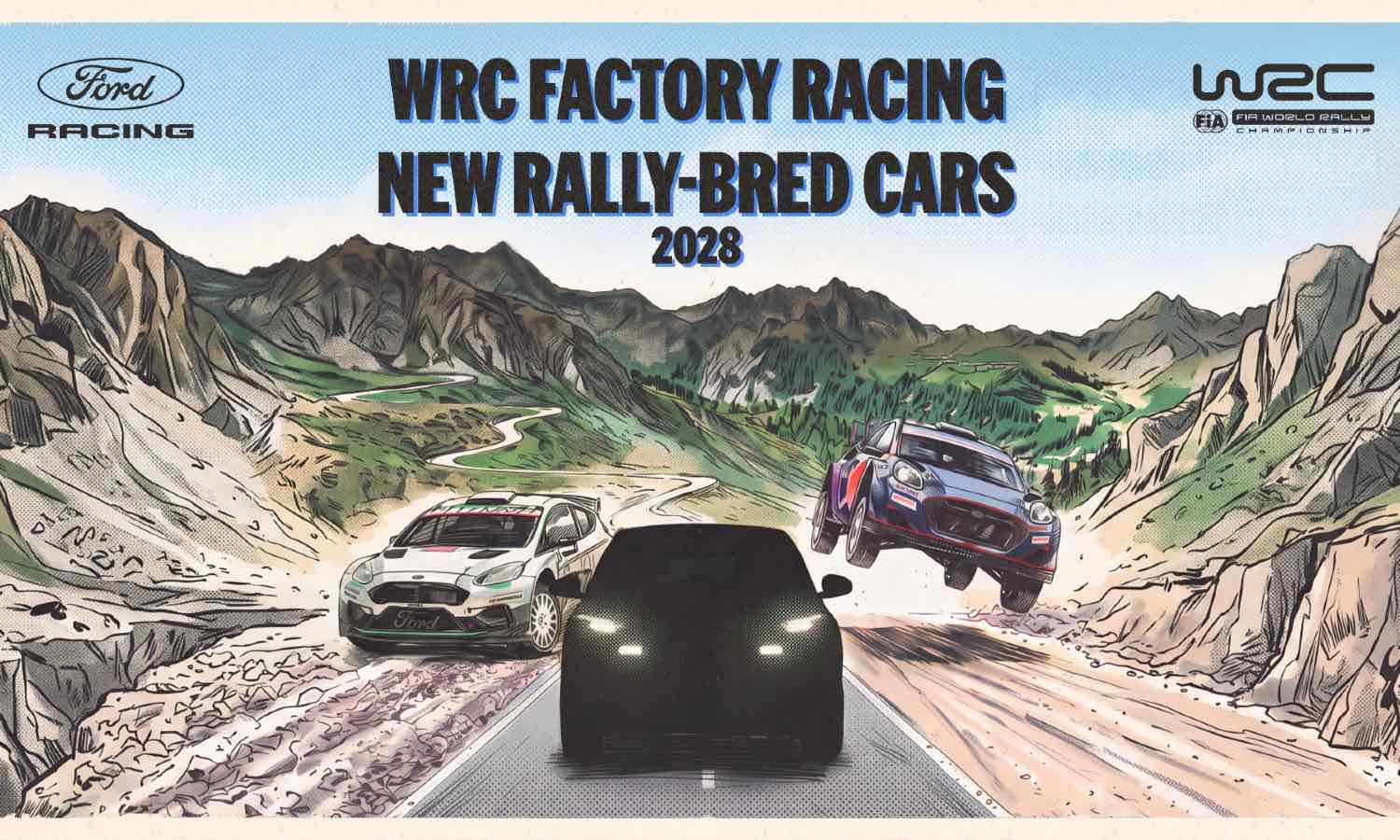
Ford has confirmed it will return to a factory-backed program in the World Rally Championship. The brand will thus resume its direct involvement, which it abandoned at the end of 2012, after more than half a century in rallying, with M-Sport as its partner for the last three decades. The return is scheduled for 2028 , although the new car won't arrive until 2029.
The news comes at a time of change for the championship. In 2027, the technical regulations known as WRC27 will come into effect, designed to cut costs and open the door to more manufacturers and independent teams. Ford becomes one of the manufacturers committed to these rules , along with Toyota and other private projects, and will leverage its presence in rallying to shape its future European range.

A two-phase return with M-Sport
Ford Racing's plan is divided into several stages. In 2027 and 2028, M-Sport will continue competing with a Ford Fiesta Rally2 adapted with a kit permitted by the new regulations, while the championship transitions between the current Rally1 cars and the future WRC27s. In 2028, Ford Racing will become directly involved as a factory team , and a year later, the completely new car will be unveiled.
That car will be a Rally1 developed under WRC27 regulations and manufactured with the support of M-Sport. The brand hasn't specified the model, but has indicated that it will be inspired by one of its upcoming European touring cars. The roadmap includes testing and car construction before 2029 , although names and exact dates have not yet been revealed.
The alliance with M-Sport is not new. The British team has kept Ford in the World Rally Championship for around thirty years and was key to the manufacturers' titles in 2006 and 2007 with the Focus RS WRC. Later, without a full factory program, they also secured the manufacturers' championship in 2017 and supported Sébastien Ogier in his 2017 and 2018 titles with the Fiesta WRC. This continuity explains why Ford is once again placing its trust in the same partner.

From WRC to street cars
Ford isn't approaching its return solely as a sporting endeavor. The company aims to transfer some of the lessons learned from rallying to its upcoming European lineup, particularly regarding responsiveness, handling, and driver engagement. The brand is preparing five multi-energy models, with electric and hybrid options , designed specifically for the continent's roads.
Jim Baumbick, president of Ford Europe, explained that rallying demands qualities that are difficult to simulate and that these values must be incorporated into the vehicles people use every day. Mark Rushbrook, global head of Ford Racing, emphasized the company's 125-year competitive history and half a century of presence in the WRC. Models like the Escort, Sierra, Focus, Fiesta, and Puma are part of that legacy.
In Spain, the announcement also has a sentimental component. Carlos Sainz took his first steps in the World Rally Championship with a Ford Sierra RS Cosworth and now competes in the Dakar Rally with a Ford Raptor . The brand will maintain its Rally-Raid program , so the return to the WRC shouldn't interfere with its desert racing activities.
Beyond rallies
Ford wants to be present on several fronts in motorsport. In addition to the WRC, it maintains its Dakar program, its role in NASCAR, its technical collaboration in Formula 1, and its return to the top class of the World Endurance Championship in 2027. From 2028, the brand will have a presence in four FIA world championships , a rare situation for a manufacturer.
The FIA has welcomed the confirmation. Its president, Mohammed Ben Sulayem, believes that Ford's return strengthens the new phase of the championship, marked by a change of promoter and the introduction of new regulations. He recalled his own experience as a Ford driver and emphasized the value of a long-term commitment.

What does this mean for the championship?
The World Rally Championship is undergoing a profound transformation. The WRC27 regulations aim to reduce the cost of competing at the elite level, facilitate the entry of manufacturers, and allow for greater technical flexibility. Ford's arrival adds to Toyota's continued presence and the independent projects already working towards the upcoming seasons.
The American brand boasts four manufacturers' titles and four drivers' titles in the top category. Björn Waldegård, Ari Vatanen, and Sébastien Ogier all feature on that list, as do the manufacturers' championships won at various times. With Ford's return, the WRC gains a historic name and a manufacturer with development capabilities in Europe.
Ford's return to the WRC won't be immediate or all at once: first will come official support with M-Sport, then the new Rally1, and, in parallel, the development of its future European touring cars. The company will maintain its activity in Dakar and other competitions, while the championship faces regulations designed to attract more manufacturers. Ford is returning to rally stages with a multi-year plan , based on its history and the need to develop more appealing road cars.