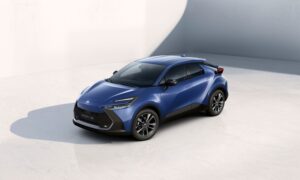
The Toyota C-HR is the Japanese brand's entry into the competitive European C-SUV segment. First unveiled in late 2016, the hybrid SUV received its first facelift in late 2019, followed by the launch of its second, completely new generation in 2023. Manufactured in Turkey, it has been a sales success since its launch, exceeding even the expectations and expectations of a giant like Toyota.
We have tested this car:
VIDEO | Toyota C-HR 200H Advance test: why is it the best option?Try Toyota C-HR 220PH, because today multi-technology is necessaryIts popularity stems in part from its bold and innovative design, a far cry from the usual conventions of traditional European style. Added to this is its hybrid concept, which earns it the DGT's ECO label and all the associated benefits. Some of the main new features of its second edition include an increased size and the addition of a plug-in hybrid version with the DGT's ZERO emissions label.
Technical characteristics of the Toyota C-HR

Beneath its sculpted and contoured silhouette lies the latest version of the brand's TNGA (Toyota New Global Architecture) platform . It was the company's first model to use it, and it was later adopted by other vehicles such as the Toyota Corolla . Its development has accommodated various powertrain solutions, all of them electrified.
Due to its dimensions, the Toyota C-HR fits perfectly into the C-SUV segment. It measures 4,36 meters long, 1,80 meters wide, and 1,55 meters high . Finally, we can add a wheelbase of 2,64 meters, which translates into a modest but adequate interior space, though not particularly luxurious for rear passengers. Up to five passengers can be accommodated in the cabin.
With only one body style available, the C-HR sacrifices some trunk space to accommodate part of its hybrid system. Components like the batteries are installed under the trunk floor. This results in a slightly lower cargo capacity compared to its competitors. The minimum capacity is 388 liters . The plug-in hybrid version has to make do with a minimum of 310 liters.
Mechanical range and gearboxes of the Toyota C-HR

As we've already mentioned, the Toyota C-HR is only available in electrified versions for the Spanish market. With the launch of its second generation, the compact crossover has expanded its lineup with two hybrid versions and a plug-in hybrid . All versions come standard with a continuously variable transmission (CVT) that sends power to the front axle.
In terms of performance, the range starts with the C-HR 140H . It features a naturally aspirated 1.8-liter four-cylinder gasoline engine paired with an electric motor and a small-capacity lithium-ion battery. It delivers a maximum power of 140 horsepower . Above it sits the C-HR 200H . Its four-cylinder engine is larger, now with a displacement of two liters. It also includes an auxiliary electric motor and the same battery. It develops 196 horsepower . In both cases, the electric range is limited to a couple of kilometers.
New to the range and positioned at the top of the performance spectrum is the Toyota C-HR 220PH . This plug-in hybrid features a naturally aspirated 2.0-liter gasoline engine paired with an electric motor and a 13,6 kWh battery. It produces 223 horsepower and boasts a homologated electric range of 66 kilometers . Charging is done via high-power systems, both DC and AC.
Equipment of the Toyota C-HR

In its quest to offer a lot at a reasonable price, Toyota presents different trim levels for the C-HR: Active, Advance, and GR Sport , plus the special launch edition called Premiere Edition. While each trim level shares the same basic appearance, the higher trims not only offer more equipment but also access to the most powerful engine and some unique aesthetic details, such as two-tone paint.
Even the base trim, the Active, includes features that will be sufficient for many customers . These include keyless entry and start, power tailgate, automatic headlights and wipers, a rearview camera, LED headlights, the Toyota multimedia system with an 8-inch screen, and the comprehensive Toyota Safety Sense suite of safety features.
The higher trim levels primarily grant access to more aesthetic options for the C-HR, such as the aforementioned two-tone paint or 18-inch wheels. But obviously, opting for these trims also brings the maximum amount of available technology. These include adaptive LED headlights, a digital instrument cluster, a 12,3-inch central touchscreen, parking cameras, dual-zone climate control, an upper instrument panel, sport front seats, ambient lighting, and much more.
Test Toyota C-HR on video
The Toyota C-HR according to Euro NCAP
As is customary after launching a new generation, Euro NCAP, the European organization responsible for monitoring and analyzing the safety of all cars, tested the Toyota C-HR during the summer of 2024, awarding it five stars— the highest possible score. The results by category are as follows: 85 out of 100 for adult occupant protection, 86 out of 100 for child occupant protection, 86 out of 100 for pedestrian vulnerability, and 79 out of 100 for ADAS systems.
The Toyota C-HR of Km 0 and Second Hand
The C-HR is a highly successful model for the brand and the market. Despite being launched at the end of 2016, its high sales figures have led to a large supply of used and pre-owned vehicles. Prices for these units start at around €16.000, with a very low depreciation rate thanks to the reliability that a brand like Toyota always offers.
The selection available in the nearly new (Km 0) market focuses exclusively on first-generation models, as the newer units have not yet arrived in Spain. Dealerships are offering their limited remaining stock with a starting price of around €27.000 for models with the entry-level 125H engine.
Rivals of the Toyota C-HR

SUV, compact, and electrified. If we consider these three characteristics, it might seem like there aren't many rivals for the Toyota C-HR , but there are. Its two main competitors also come from Asia. On the one hand, there's the Kia Niro , launched practically at the same time as the Japanese model, and on the other hand, the more modern Hyundai Kona in its hybrid variant. Between the three of them, they're trying to dominate a segment that, for the moment, isn't very saturated. Without a doubt, the leader at the moment is the C-HR.
Highlight
- Design
- 180H mechanics
- low consumption
To improve
- lack of benefits
- small indoor
- scarce trunk
Toyota C-HR prices
The new generation has done wonders for the C-HR. Thanks to the introduction of new engines and more equipment, we can say it's a better car, but this has led to a slight price increase. The starting price for a Toyota C-HR is €31.750 for the base trim and engine. The most expensive version starts at €48.150. This particular model is a C-HR PHEV with 223 horsepower and a zero-emissions sticker from the Spanish Directorate General of Traffic (DGT).
Image gallery




Table of Contents
- 1 Technical characteristics of the Toyota C-HR
- 2 Mechanical range and gearboxes of the Toyota C-HR
- 3 Equipment of the Toyota C-HR
- 4 Test Toyota C-HR on video
- 5 The Toyota C-HR according to Euro NCAP
- 6 The Toyota C-HR of Km 0 and Second Hand
- 7 Rivals of the Toyota C-HR
- 8 Highlight
- 9 To improve
- 10 Toyota C-HR prices
- 11 Image gallery
The latest on Toyota C-HR
-

-
-
-
-
-
-
-
-
-
-
-