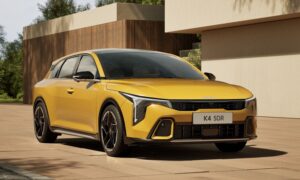
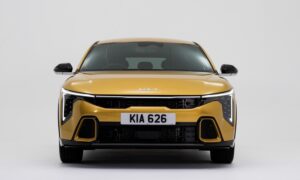
The compact car segment remains one of the most important in the industry despite the unstoppable rise of SUVs. All brands compete within it, especially in the mainstream category. The KIA Ceed is the Korean brand's offering, a product that has gradually become more "Europeanized," gaining considerable appeal.
We have tested this car:
Test Kia Ceed 1.5 MHEV 160 CV GT-Line (with video)Test Kia ProCeed GT 1.6 T-GDi 204 hpIt was launched in 2007. It could be considered one of the newest compact cars on the European market. It was a completely new product, a sister model to the Hyundai i30 , the Korean conglomerate's twin. However, the first time we saw the Ceed, it wasn't called what it is now, since back then its official name was Cee'd.
That illogical final apostrophe disappeared with the arrival of the latest generation, officially unveiled at the 2018 Geneva Motor Show . This model reached maturity in 2021 thanks to an interesting restyling. As a result, it has become one of the most sensible and versatile options available today, offering three body styles: hatchback, station wagon (Tourer), and Shooting Brake (Proceed).
Currently, there has been a gradual replacement towards the K4 and EV4 , the new versions that continue this concept…
Technical characteristics of the KIA Ceed

Korean brands have evolved considerably since their first models arrived in our market. The KIA Ceed is based on the J6 platform, shared with the i30 . This state-of-the-art platform was fine-tuned by Albert Biermann, who a few years ago was the chief engineer and founding father of the BMW Motorsport division.
The various Ceed body styles offer different dimensions. The hatchback measures 4,31 meters long, 1,8 meters wide, and 1,45 meters high . The station wagon, the KIA Ceed Tourer, extends to 4,6 meters long, 1,8 meters wide, and 1,46 meters high. Finally, the KIA Proceed, with its elegant Shooting Brake body style, measures 4,6 meters long, 1,8 meters wide, and 1,42 meters high.
Despite the variations, all models share the same wheelbase: 2,65 meters. Their interior space is certified for a maximum of five passengers. Cargo capacities differ depending on the body style. The KIA Ceed offers a minimum trunk capacity of 395 liters for the hatchback, 594 liters for the Proceed, and 625 liters for the KIA Ceed Tourer. All these figures increase when the second row of seats is folded down.
Mechanical range and gearboxes of the KIA Ceed

The KIA Ceed offers a wide and varied range of powertrains, although not all body styles feature the same options. As is typical these days, it includes gasoline combustion engines, mild hybrid (MHEV) units, and plug-in hybrids . It also offers sporty versions designated as GT (which were discontinued in 2024 due to non-compliance with European emissions standards).
The range starts with the 1.0 T-GDi petrol engine producing 100 horsepower, available with or without a mild hybrid (MHEV) system and earning an ECO label. It comes standard with a six-speed manual transmission, but a seven-speed DCT is also available. Above this is the 1.5 T-GDI with 140 horsepower and a mild hybrid system. At the top of the range is the special KIA Proceed engine, a 1.5 T-GDI MHEV with 160 horsepower.
Plug-in hybrid technology is exclusively available on the station wagon version, the KIA Ceed Tourer. It features a naturally aspirated 1,6-liter four-cylinder engine paired with a front electric motor powered by an 8,9 kWh gross capacity lithium-ion battery. The official maximum electric range is 50 kilometers, with a combined fuel consumption of 1,3 liters per 100 kilometers. In Spain, it qualifies for the DGT's ZERO emissions label.
Equipment of the KIA Ceed

It must be acknowledged that KIA has done a great job with the interior of the Ceed. Inside, it presents itself as a compact car that stands out from the rest, both in terms of technology and quality . Pleasant-to-the-touch surfaces are combined with decent plastics that, overall, enhance the perceived quality for all occupants.
As is customary for the brand, the equipment is distributed in very specific packages that simplify the buying process for the user. From least to most equipped, these are: Concept, Drive, Tech, GT Line, and GT . In addition to these, there is the eMotion trim level, exclusive to the PHEV variant of the Ceed Tourer. Each trim level primarily alters the number of systems included, although there are also variations in finishes, quality, and design.
Technology is a decisive factor in purchasing decisions in the C segment, and therefore the Ceed offers its customers many interesting options, which will be improved from 2021 onwards. Highlights include: LED headlights, digital instrumentation, a multimedia system with a 10,25-inch touchscreen, a parking camera, navigation, mobile device connectivity, a sunroof, and a comprehensive suite of driver assistance and safety systems.
Test KIA Ceed in video
The KIA Ceed according to Euro NCAP
In 2019, Euro NCAP tested the safety of the third-generation KIA Ceed. Following the crash tests, the European assessment body awarded it four out of five safety stars . The results by category were as follows: 8,8 for adult occupant protection, 8,5 for child occupant protection, 5,2 for pedestrian vulnerability, and 6,8 for driver assistance systems. These results are valid for all three body styles, as they all share the same technologies and platform. These ratings remain valid for the 2021 models, as there are no changes to the car's structure.
The Kia Ceed of Km 0 and second hand
The KIA Ceed, or rather the Cee'd, was the brand's first model designed for the European market. This compact car has consistently achieved modest but respectable sales figures. Over the years, it has built a solid reputation for durability and handling, which has ultimately impacted its resale value, where it shows an average depreciation of 30% . This figure is very similar to that of its direct competitors.
Looking at the used car market, we see that the most affordable models are from the first generation (2006-2011). Prices start at around €2.000 for gasoline models with over 150 kilometers on the odometer. The nearly new (Km 0) market offers a wide variety of vehicles depending on body style and engine. The most expensive models are the higher-spec versions of the KIA Proceed.
KIA Ceed Rivals

The KIA Ceed falls into one of the most popular and competitive segments of the market. The list of rivals is very long and varied . Every brand offers at least one possible alternative, and many of them are within the mainstream segment. The Korean car's natural enemies are: Renault Mégane , SEAT León , Ford Focus , Peugeot 308 , Citroën C4 , Toyota Corolla , FIAT Tipo , Mazda3 , Opel Astra , Skoda Scala , and the all-powerful Volkswagen Golf . They are all similar in characteristics, although the KIA is the only one that offers three different body styles.
Highlight
- Elegant and sporty design
- Value for money-equipment
- 7 years warranty
To improve
- Security level
- Access Versions
- Few sensations behind the wheel
KIA Ceed Price
One of the Ceed's greatest strengths is its excellent value for money. While it's no longer as cheap as it once was, it remains one of the most attractive compact cars in that regard. The starting price for the KIA Ceed is €19.540, excluding any offers or promotions . This price corresponds to a five-door Ceed with a 1.0 T-GDi 100-horsepower engine, manual transmission, and Concept trim level. The Ceed Tourer raises the starting price to €22.490, also excluding offers or promotions. Finally, the most expensive in the family is the KIA Proceed, which starts at €32.430, also excluding discounts or promotions.
Image gallery


Table of Contents
The latest on KIA Ceed
-
 Kia K4: prices, engines and details of the new compact for Europe
-
-
-
-
-
-
-
-
-
-
-